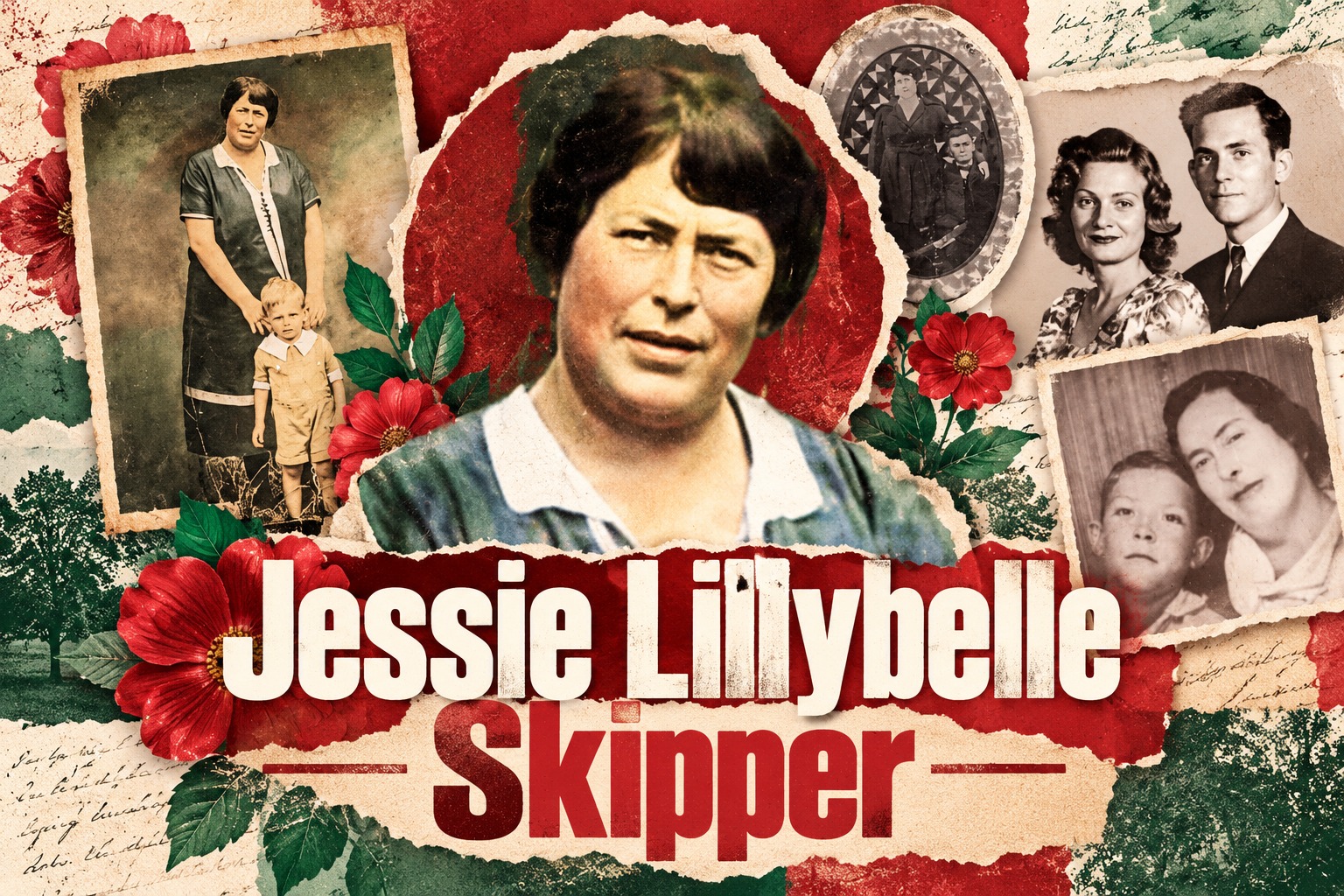
Jessie Lillybelle Skipper is remembered as Lillie or Mama Lillie, the mother who helped Hank Williams find his earliest stages. I see her contribution in practical work as much as musical encouragement. She earned money, ran a boarding house, obtained a guitar, and organized performances. Before her son became a country music landmark, there was a household to keep going and a young performer who needed opportunities.
Born on August 12, 1898, Jessie married Elonzo Huble Williams on November 12, 1916. Her life would include the loss of an infant, raising Irene and Hank, and a brief period caring for a granddaughter after Hank’s death. She died on February 26, 1955, leaving a family story whose public musical branches continued to grow.
Marriage to Elonzo Williams
Elonzo, often called Lon, was born in 1891 and worked in lumber and railroad related employment. He served during World War I, with his service recorded from July 1918 to June 1919. Later health difficulties and a serious injury affected his place in family life.
Jessie’s responsibilities grew within that setting. The supplied account describes her doing much of the work of providing for the children while Lon struggled with his health. The established pattern is sufficient: her labor helped sustain the household through years when the family faced practical difficulty.
Lon outlived Jessie and died in 1970. His later life included another marriage after her death. Those dates help keep the family chronology clear. Jessie was not present for the many decades in which Hank’s descendants and musical estate would continue to receive attention.
Ernest Irene and Hiram
Jessie and Lon’s first child, Ernest Huble Williams, died in infancy, with family records placing the brief life in July 1921. Their daughter Irene was born on August 8, 1922. Hiram Williams followed on September 17, 1923, in Mount Olive, Alabama, and became known as Hank.
Irene was Hank’s older sister, not another of his children or a member of the later musical generation. Her adult life is less extensively described than his, although the family record places her life into the 1990s. I find it useful to retain her name because the enormous attention given to Hank can make the original household appear to consist only of mother and famous son.
Hiram’s professional name became so familiar that it can obscure the childhood identity behind it. Jessie raised a boy called Hiram before she helped support the performer known as Hank Williams. That progression places her role before the recordings, royalties, and reputation that later dominated the family’s public history.
Earning a Living and Making Room for Music
Jessie’s working life included practical nursing, cleaning, sewing, and running a boarding house in Montgomery. These were the activities through which she provided for her family. She was not established as a professional recording artist, and there is no need to invent that identity to explain her importance to music.
Family recollections describe her buying Hank an inexpensive secondhand guitar. She also supported his early exposure to church music. I see those acts as opening a door rather than composing the career that followed. The instrument and encouragement made practice possible, but Hank’s later songwriting and performances remained his own work.
The boarding house became connected with his early band life. Accounts describe musicians receiving housing and food there. That made Jessie’s business a practical support for performing, joining household income and musical activity under the same roof. The arrangement gave early music a place to gather before larger audiences were available.
An Early Organizer and Manager
Jessie arranged local appearances and radio opportunities, transported musicians, and helped manage the demands around Hank’s early work. Her role is often described as that of an early manager or organizer. The description fits the practical activities rather than a formal corporate title.
I find this part of her biography especially tangible. A promising musician still needs to reach a performance, find an audience, and keep a band together. Jessie’s work supplied some of that machinery. It was the engine beneath the melody, less celebrated than a song but necessary to getting the song heard.
Her influence should not be inflated into control over every later professional decision Hank made. His career developed beyond those beginnings. The established achievement is her support during the period when local experience and exposure mattered, not an undocumented lifetime management contract.
Two Grandchildren and a Difficult Succession
Hank Williams Jr., born Randall Hank Williams in 1949, was Jessie’s grandson through Hank. Hank’s daughter Jett Williams was born on January 6, 1953, five days after his death on January 1. Jett’s mother was Frances Bobbie Jett, generally known as Bobbie Jett.
Jessie cared for Jett during the period immediately after Hank’s death, with adoption and guardianship arrangements forming part of a complicated legal history. Her own death in 1955 interrupted that relationship.
Jett later pursued recognition and rights in Hank’s estate. Many of the best known proceedings happened decades after Jessie died. Jessie belongs to the early family and caregiving chapter of that story, while later court victories and royalty decisions belong to Jett and the subsequent legal history.
The Later Williams Generation
Through Hank Williams Jr., Jessie was the great grandmother of musicians and other descendants including Shelton Hank Williams, known as Hank Williams III, Holly Williams, Hilary Williams, Sam Williams, and Katharine Diane Williams. Katharine died in 2020. These later lives extended the family’s public presence long after Jessie’s death.
Their connection is genealogical, while their careers have their own beginnings. Nor is a verified personal fortune established for Jessie. Her life is described through paid work and family responsibilities, and Hank’s later royalties cannot be treated as a direct measure of her wealth.
FAQ
Was Jessie Lillybelle Skipper Hank Williams’s mother?
Yes. Jessie and Elonzo Huble Williams were the parents of Hiram, professionally known as Hank Williams. They also had Irene and an infant son, Ernest, who died shortly after birth.
How did Jessie help Hank’s early career?
She bought him a guitar, supported his musical interests, arranged appearances and radio opportunities, and helped transport and house early musicians. Her work and boarding house also supported the family financially.
How was Jett Williams related to Jessie?
Jett was Jessie’s granddaughter through Hank Williams and Bobbie Jett. Born shortly after Hank’s death in January 1953, she received care from Jessie before Jessie’s own death in February 1955.